

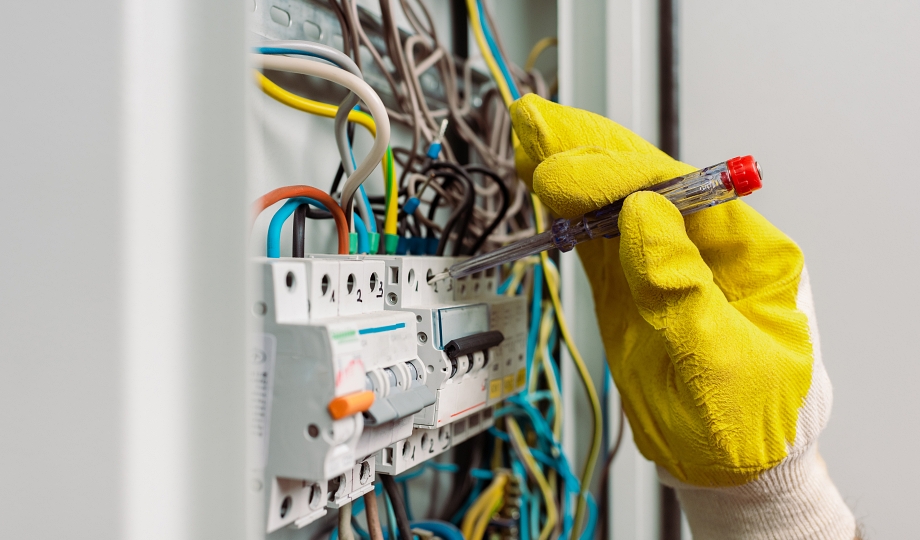
If you want a job or career in electrical work, you should learn how to read electrical wiring diagrams. Reading electrical wiring diagrams requires understanding standardized symbols, tracing the power path, and recognizing how components interact in a de-energized state. The best training comes with earning an Electrical Technology Certificate, which prepares you for entry-level electrical work. Contact ITI Technical College today for more information.
Basics Of How To Read Electrical Wiring Diagrams
One of the first things electrical students begin to learn is how to read wiring diagrams. You can think of how electricity flows through the wires as water flowing through plumbing pipes. Not sure which trade fits you best? Compare HVAC and electrical technology programs.
These are the key steps to understand a wiring diagram:
- Start at the Power Source: Locate the main voltage supply, battery, or service panel to see where energy enters the circuit.
- Check the Legend and Title Block: Find the symbol key, abbreviation list, and title block (usually bottom-right) for project data, page numbers, and revision history.
- Trace Current Flow: Follow lines from positive/hot sources through control devices (switches, buttons) down to the final loads (motors, lights). Read diagrams left-to-right and top-to-bottom.
- Understand Line Crossings: A dot at a wire intersection generally means the conductors are connected; crossing lines without a dot pass over each other without connecting.
- Assume a Neutral State: Remember that diagrams show equipment in a de-energized, resting, or off position.
A Deeper Understanding Of Electrical Wiring Diagrams
Once you locate the main power source, study the legend and title block. Always locate the legend page first. It acts as a key explaining every graphical symbol used in the drawing, such as switches, relays, and fuses.
Check for specialized shorthand abbreviation definitions, such as MCB for miniature circuit breaker or PE for protective earth. Read the title block because it provides critical context including the drawing scale, project revision history, designer notes, and page grid coordinates.
|
“The best training comes with earning an Electrical Technology Certificate.” |
Identify The Power Source And Flow Direction
 As an electrical student, you must not confuse alternating current (AC) with direct current (DC) electricity. The main difference between AC and DC is the direction the electricity flows: AC changes direction back and forth, while DC flows in only one constant direction. Observe the following on a wiring diagram:
- AC vs. DC Orientation: AC power circuits are typically followed from left to right starting at the power supply or breaker. DC schematic rails usually place the positive line at the top and the negative/common line at the bottom, flowing top-to-bottom.
- Neutral and Ground: Solid lines generally indicate wiring and active power or signal paths, while dashed lines often show optional connections, mechanical links, or equipment boundaries. Neutral and protective earth (PE) conductors are usually identified by labels, color codes, or ground symbols.
Understand Component Symbols And States
The next concepts to comprehend are the component symbols and electrical states. Diagrams are conventionally drawn in their resting, non-energized (neutral) state. Switches, push buttons, and relay contacts reflect how they look before power is applied or operated.
Core elements include fuses (F) that protect against overcurrent, contactors and relays (K or KM) that manage load switching, and loads like motors (M) or lamps (H) that represent the end output. Letter codes can vary between IEC and North American drawings, so always check the legend. An electric fuse is a safety device critical for protecting wiring and appliances from damage caused by too much electric current. An electrical contactor or relay is an electrically operated switch that uses a low-power control signal to open or close a separate electrical circuit. Working around electrical equipment always carries risk, so review OSHA’s electrical safety guidance before handling any live circuit.
Trace Connections And Cross References In Electrical Wiring Diagrams
The last concepts to grasp in reading electrical wiring diagrams are tracing connections and cross references, including grid and rung numbers, and following a loop.
- Grid and Rung Numbers: Ladder diagrams and complex schematics use row/column indices or wire numbers to map multi-page connections.
- Following a Loop: Track individual nodes (terminal junctions) from the source through control interlocks and protective devices to verify how a complete circuit closes.
Advanced Electrical Studies
If you want more knowledge and skills in electrical technology, you should consider earning certifications in this field. Electricians need state-issued licenses to work legally, while certifications are optional credentials used to prove safety training, special skills, show you are dedicated, and have qualifications for advancement. Most states require a license, and requirements vary, according to the U.S. Bureau of Labor Statistics. The following are common credentials:
Essential Licenses (Required to Work)
- Apprentice License: Allows you to learn on the job under a licensed electrician. Requirements vary by state.
- Journeyman License: Typically requires 4 to 5 years (about 8,000 to 10,000 hours) of hands-on training and a passing exam score on the National Electrical Code (NEC). With it you can work independently.
- Master Electrician License: Requires extra years of experience past the journeyman level. It allows you to supervise others and pull official work permits.
Core Safety Certifications (Voluntary or Employer-Mandated)
- OSHA 10 or OSHA 30: Safety courses covering job-site hazards and accident prevention.
- NFPA 70E: Training based on the NFPA 70E standard for workplace electrical safety, including arc flashes and proper protective gear.
Specialized Certifications (For Career Growth)
- Solar / Photovoltaic (NABCEP PVIP): Proof of skill in installing green energy and solar panel systems.
- Low-Voltage / Fiber Optics: Credentials for working on telecommunications, alarms, and data wiring.
- Certified Electrical Inspector (CEI): Qualifies an electrician to inspect completed projects for code compliance.
Many students start with a certificate. Learn how the Electrical Technology Certificate offers a fast-track route into skilled trade careers. You can also read about why electrician jobs are in high demand with great pay.
ITI Technical College has graduated thousands of technical students since 1973. You can start your training in the Electrical Technology Certificate Program, and when you are ready, explore what we have to offer your career.
Disclosure:
For more information about graduation rates, the median debt of students who completed the program, and other important information, please visit our website: https://iticollege.edu/disclosures/