

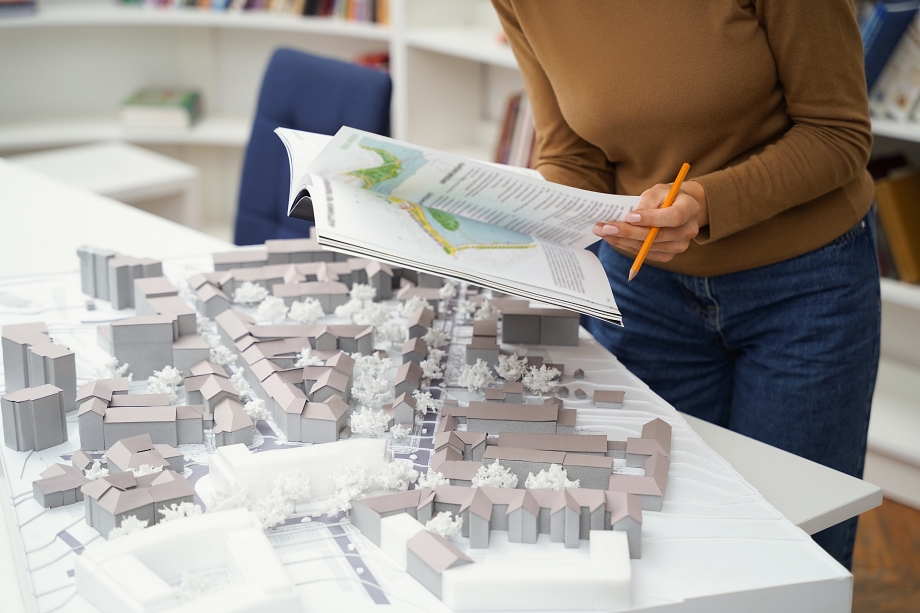
If you are comparing drafting/design with architecture as careers, the biggest difference is the level of responsibility, education, and creative/technical scope. Think of it this way to see the important distinction between the two:
Architect: “What should we design, and how should the building work?”
Drafter/BIM designer: “How do we accurately represent that design so it can actually be built?”
There is considerable overlap, though. Drafting can also be a stepping stone toward architecture, especially if you discover you enjoy building design but want greater responsibility and creative control.
If you are choosing between the two as a career, drafting/design is usually the shorter, lower-cost path, while architecture is the longer path with greater professional responsibility and scope. Hundreds of companies regularly hire drafters and designers with associate degrees. Contact ITI Technical College today for more information.
Drafting & Design In Perspective
 Drafting is primarily about turning designs and ideas into precise technical drawings and digital models. It is a good fit if you like computers, measurements, technical details, 3D modeling, and making things accurately.
- Usually involves CAD/BIM software such as AutoCAD, Revit, or SolidWorks.
- Specialize in architecture, construction, mechanical systems, electrical systems, civil drafting projects, or manufacturing.
- Often requires an associate degree, certificate, or technical training rather than a professional architecture degree.
- Work tends to be more technical and detail-oriented.
- You typically work under engineers, architects, or other designers.
- Entry into the field is generally faster and less expensive.
What Drafters And Designers Do
Drafters focus on technical accuracy and turning designs into detailed, construction-ready blueprints or schematics. They use Computer-Aided Design (CAD) software to create 2D and 3D drawings. Drafters convert rough sketches, notes, and specifications into clear instructions for builders. They add exact dimensions, material types, and procedural notes to plans.
Designers focus more on the conceptual and functional creation of a product or structure. They conceptualize the overall look, functionality, ergonomics, and safety of a product or system. Designers choose appropriate materials and analyze how a part will be manufactured or built.
They make high-level design decisions and solve structural or mechanical problems. These professionals use 3D modeling tools like SolidWorks or Fusion 360 to build and test virtual prototypes.
What Is Architecture Drafting
Architecture involves designing buildings and taking responsibility for how those buildings function, look, comply with codes, and are constructed. It is a good fit if you like: designing spaces, creativity, problem-solving, buildings, working with clients, and taking ownership of larger projects.
- Requires substantially more education and professional training.
- In the U.S., becoming a licensed architect generally involves an accredited professional degree, practical experience, and passing the Architect Registration Examination.
- Architects make higher-level design decisions and coordinate many aspects of a project.
- The work combines creativity, engineering concepts, building science, communication, business, and regulations.
- Projects can take years and involve considerable responsibility.
What Architects Do
 Architects plan, design, and oversee the construction of buildings, homes, and spaces. They turn a client’s ideas and needs into safe, useful, and attractive physical designs, balancing artistic vision with practical rules, budgets, and safety laws. Their core duty is designing and planning by meeting with clients to discuss goals, drawing initial sketches, and creating 2D or 3D blueprints using computer software.
Architects ensure plans follow local building codes, zoning laws, and safety rules. They work closely with a team of engineers, interior designers, and construction workers to plan structural, electrical, plumbing, and HVAC systems. Project management is something that drafters and designers do not participate in. Architects estimate costs and timelines, prepare legal and material contracts, and visit work sites to check building progress.
Employment Prospects For Drafting, Design, And Architecture
A good place to see employment opportunities is by examining the Bureau of Labor Statistics (BLS) website. According to the Bureau of Labor Statistics (BLS), about 14,400 openings for drafters are projected each year, on average, from 2025 to 2035, mostly to replace workers who retire or change occupations.
Employment prospects for designers are declining slightly for traditional print roles, but expanding rapidly for digital, motion, and UX/UI specializations. According to the Bureau of Labor Statistics (BLS), employment of graphic designers is projected to decline 2% from 2025 to 2035, although about 16,000 openings are still projected each year. Demand is much stronger for digital-focused career paths. The BLS projects employment of web developers and digital designers to grow 5% from 2025 to 2035, while specialized UX/UI and motion graphics fields see higher demand.
According to the Bureau of Labor Statistics (BLS), employment of architects is projected to grow 4% from 2025 to 2035, about as fast as the average for all occupations. About 6,900 openings for architects are projected each year over the decade, mostly driven by the need to replace workers who retire or switch careers. Demand is tied to commercial and residential building, sustainable “green” design, and retrofitting aging infrastructure.
Preparing for a career in drafting and design requires only 2 years of full-time college preparation. Earn your Associate of Occupational Studies (AOS) Degree in Drafting & Design Technology at ITI Technical College. Apply now!
Disclosure:
For more information about graduation rates, the median debt of students who completed the program, and other important information, please visit our website: https://iticollege.edu/disclosures/