
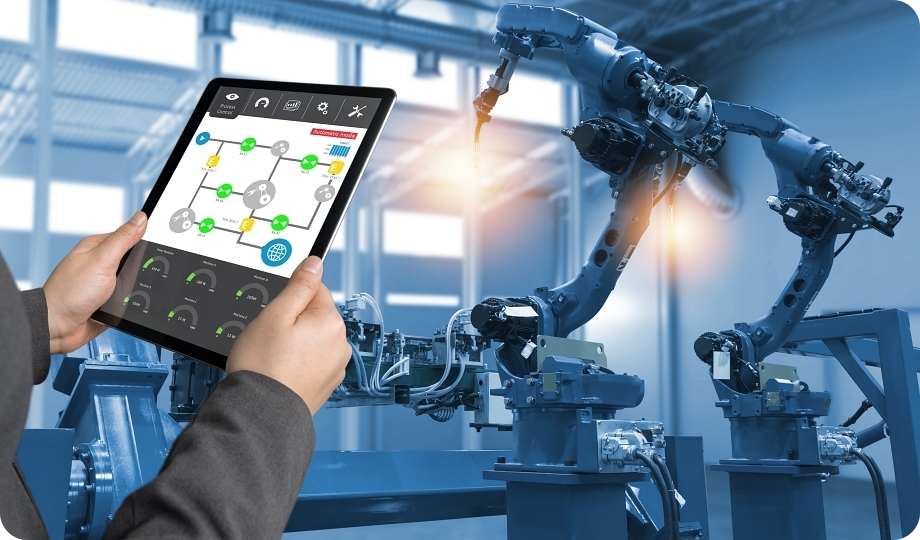
SCADA stands for Supervisory Control and Data Acquisition, a software and hardware combination that lets operators monitor and control industrial equipment and processes in real time from a central location. For automation and electronic systems students, think of SCADA as the “brain and nervous system” of large-scale operations—such as water treatment plants, power grids, and manufacturing assembly lines—to make the concept easier to understand. Contact ITI Technical College today for more information.
What Is SCADA And How It Works
SCADA is a category of industrial control systems that remotely collects real-time data from industrial processes. It is used to supervise and control equipment and conditions as a system that bridges the physical plant floor with digital control rooms. SCADA supports data-driven decisions about almost any type of industrial process through a graphical user interface (GUI). The live data it collects can also feed digital twins that model physical equipment. SCADA performs four core actions:
- Supervisory: Provides a high-level, centralized view of massive operations instead of forcing technicians to check every single machine manually.
- Control: Lets operators send direct commands (like opening a valve or changing a motor speed) back down to field devices.
- Data: Captures continuous live measurements from the environment.
- Acquisition: Gathers sensor information continuously using industrial communication protocols.
Core Components Of SCADA
Automation and electronic systems students should be well-versed in the core components of SCADA. A standard SCADA architecture relies on five main layers working together:
- Field Devices (Sensors and Actuators): The physical touchpoints. Sensors measure temperature, pressure, or flow, while actuators, pumps, and valves execute physical changes.
- PLCs and RTUs (Controllers): Microcomputers sitting near the equipment. PLCs (Programmable Logic Controllers) handle high-speed local automation, while RTUs (Remote Terminal Units) transmit telemetry data over long distances from remote sites like substations or pipelines.
- Communication Network: The wired or wireless pathways carrying data between the field controllers and the control room using protocols like Modbus, MQTT, or OPC UA.
- SCADA Server & Historian: The central software hub that aggregates real-time signals, manages alarms for system faults, and logs historical data into databases for performance tracking and trend analysis.
- HMI (Human-Machine Interface): The graphical dashboard screens in the control room where human operators view live schematics, track alerts, and adjust system inputs.
Because SCADA networks connect plant floors to control rooms, security matters. The National Institute of Standards and Technology covers it in its Guide to Operational Technology (OT) Security.
“For automation and electronic systems students, think of SCADA as the ‘brain and nervous system’ of large-scale operations.” |
Key Industries And End-User Companies
 While software vendors build the technology, thousands of end-user organizations operate with SCADA each day. Major energy and utility companies, including oil, gas, and power grid operators, use SCADA to monitor pipelines, substations, and generation units over vast geographic areas. These systems are part of the industrial control systems that critical infrastructure sectors rely on to monitor and control their processes. To see how this plays out locally, read about Louisiana’s energy sector and what it means for instrumentation grads.
Manufacturing and automotive companies use SCADA to visualize assembly line performance and track machine metrics. Mining companies use SCADA for dewatering, milling, and ventilation monitoring in mining and infrastructure operations. Water utilities depend on it too, and you can learn how instrumentation technicians work in water treatment plants.
Examples Of Well-Known Corporations That Use SCADA
Major global automation providers design and supply SCADA systems. Thousands of industrial enterprises in manufacturing, energy, and utilities use them to monitor and control operations. Top SCADA software and hardware providers include:
- Siemens: Offers SIMATIC WinCC, engineered through TIA Portal, widely used in automotive, energy, and heavy manufacturing.
- Rockwell Automation: Known for its FactoryTalk View and FactoryTalk Optix suites, heavily adopted in discrete and batch manufacturing.
- Schneider Electric: Provides EcoStruxure Geo SCADA Expert and AVEVA (formerly Wonderware) software, widely used in water treatment and oil and gas.
- Inductive Automation: Creator of the Ignition platform, widely deployed across manufacturing, mining, and infrastructure.
- ABB: Delivers secure real-time SCADA and control platforms for power grids and process industries.
- Proficy (formerly GE Digital): Supplies iFIX and Proficy SCADA for power generation and industrial plants.
- Honeywell: Offers the Experion Process Knowledge System (PKS) for large refineries and chemical plants.
Earn A Degree In Automation And Electronic Systems Technology
 The objective of this program is to prepare students to work in entry-level positions in industrial and commercial automation and electronic applications. Graduates will be capable of installing, maintaining, and troubleshooting basic electronic equipment and systems in entry-level positions including:
- Industrial Control System Technician
- Manufacturing Automation
- Remote Operated Vehicle (ROV) System Technician
- Home Automation System Technician
- Alarm System Technician
- Video Monitoring System Technician
- Electronic System Technician
- Medical Equipment Technician
- Communications Equipment Technician
The Automation & Electronic Systems Technology (AOS) Associate in Occupational Studies Degree Program is designed to equip graduates with real-world skills in analog and digital electronics with a focus on microprocessor control. Studies include classroom and laboratory work in these areas:
- Digital Multimeters (DMMs), Oscilloscopes, Function Generators, and Logic Probes
- Introductory and Advanced Programmable Logic Controllers (PLCs) as they apply to industrial control and motor control
- Low Voltage and Fiber Terminations, Introductory and Applied Microprocessors (µP)
- Introductory Microprocessor training where students build their own microprocessor trainer as they learn microprocessor architecture and basic I/O systems
- Applied Microprocessor training uses the Arduino platform to allow students to design and construct a final control project of their choosing
- Basic computer applications and applied technical writing
A basic networking course will introduce students to the equipment and concepts used in setting up a basic computer network. Elective course choices include instrumentation courses covering the basics of flow, level, temperature, and pressure. Information Technology courses such as software applications, network security, web design, and A+ certification are offered.
Program Teaching Methods
The teaching methods used in this program include instruction in classroom theory and lab sessions. All electronic principles presented are supported extensively with hands-on labs that concentrate on the use of equipment used in troubleshooting today’s electronic control systems. Studies are individualized, and progress is monitored with assignments, quizzes, and laboratory evaluations.
It’s easy to find out more about the Automation & Electronic Systems Technology (AOS) Associate in Occupational Studies Degree program and ITI Technical College by requesting information online.
Disclosure:
For more information about graduation rates, the median debt of students who completed the program, and other important information, please visit our website: https://iticollege.edu/disclosures/