


In today’s digital world, almost everything depends on data centers. From sending an email and streaming a movie to processing financial transactions and powering artificial intelligence, countless digital services rely on the infrastructure housed inside these highly specialized facilities. Yet, while data centers are often described in terms of servers, storage systems, cooling equipment, and networking hardware, one essential element can be overlooked: the people who keep everything running.
Behind every reliable data center is a team of IT professionals, engineers, technicians, security specialists, and operations personnel working around the clock. Their job is to ensure that the technology businesses and consumers depend on remains available, secure, efficient, and resilient. Contact ITI Technical College today for more information.
IT Professionals: The People Behind the Infrastructure
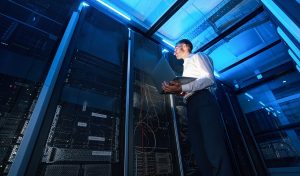 A modern data center is far more complicated than a room filled with computers. It is an interconnected environment involving computing equipment, networking, power distribution, environmental controls, cybersecurity systems, monitoring tools, and physical security. These are the core activities data center professionals participate in:
- Data center professionals are responsible for managing these components and making sure they work together.
- The workforce may include data center technicians, systems administrators, network engineers, cloud engineers, cybersecurity specialists, facilities engineers, database administrators, and IT managers.
- Each role has distinct responsibilities, but they share a common objective: keeping critical services available.
- Data center technicians, for example, may install and replace servers, troubleshoot hardware failures, manage cabling, and perform routine inspections.
- Network engineers maintain the systems that allow servers and other devices to communicate with each other and with external networks.
- Systems administrators oversee operating systems, applications, and configurations, while cybersecurity professionals work to protect infrastructure and data from unauthorized access and attacks.
Keeping Systems Available 24/7
One of the biggest challenges in data center operations is availability. Many organizations cannot afford significant downtime. A disruption to a data center can affect websites, applications, payment systems, communications, business operations, and even essential public services.
This is why data center teams continuously monitor infrastructure. Sophisticated monitoring systems can identify unusual temperatures, network problems, failing hardware, power fluctuations, and other potential issues. Professionals analyze these alerts and determine whether immediate action is necessary.
Preventive maintenance is equally important. IT teams regularly inspect equipment, update systems, replace aging components, test backup procedures, and review performance. The goal is not simply to fix problems when they happen but to identify weaknesses before they become major failures. In many facilities, this work takes place 24 hours a day, seven days a week. Different shifts ensure that trained personnel are available whenever something goes wrong.
|
“Behind every reliable data center is a team of IT professionals, engineers, technicians, security specialists, and operations personnel working around the clock.” |
IT Professionals Manage Power And Cooling
Computing equipment generates significant amounts of heat and requires a reliable power supply. As servers become more powerful, particularly with the growth of artificial intelligence and high-performance computing, managing power and cooling has become increasingly important. IT professionals work with these responsibilities:
- Although facilities engineers often specialize in these areas, IT professionals must understand how environmental conditions affect technology.
- A server can fail if it overheats, while an electrical problem can bring down an entire section of infrastructure.
- Data center teams therefore work closely across technical and facilities disciplines.
- Backup generators, uninterruptible power supplies, cooling systems, temperature sensors, and environmental monitoring tools all contribute to reliability.
- The challenge is becoming even greater as organizations seek to increase computing capacity while controlling energy consumption. Professionals must balance performance, reliability, cost, and efficiency.
Cybersecurity: Protecting the Data Center
Keeping a data center operational is only half the job. Its systems and information must also be protected. Cybersecurity professionals defend infrastructure against threats ranging from malware and ransomware to unauthorized access and sophisticated cyberattacks. Their responsibilities can include monitoring network activity, managing access controls, applying security updates, investigating suspicious behavior, and developing incident-response plans.
Physical security is important as well because data centers often contain valuable equipment and sensitive information. Access may be restricted through identification systems, surveillance cameras, biometric controls, and other security measures. Modern data center security is therefore a combination of digital and physical protection. A vulnerability in either area can create serious consequences.
The Future of Data Center Careers
As dependence on digital services continues to grow, the need for skilled data center professionals is likely to remain strong. The expansion of cloud computing, artificial intelligence, edge computing, and increasingly data-intensive applications is creating new demands for infrastructure.
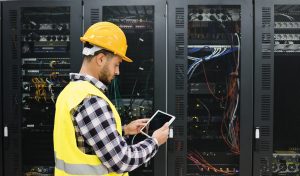 Future professionals may work alongside increasingly autonomous systems, but human oversight will remain critical. Organizations will need people capable of designing resilient infrastructure, managing complex environments, responding to incidents, protecting systems, and improving efficiency.
As our dependence on digital infrastructure grows, these professionals will become even more important. They are, in many ways, the people behind the machines—and among the most important guardians of the always-connected world.
The Unsung Workforce of the Digital Age
When a website loads instantly, a video streams without interruption, or an online transaction is completed in seconds, users rarely think about what makes that experience possible. Behind the scenes, however, teams of IT professionals are monitoring systems, maintaining equipment, securing networks, managing power, solving problems, and preparing for failures that may never happen.
Data centers may be filled with sophisticated machines, but machines alone do not keep the digital world running. It is the knowledge, vigilance, and judgment of IT and infrastructure professionals trained in college that turn complex technology into reliable services.
If your future lies in the world of IT and data centers, earn your Information Technology (AOS) Associate in Occupational Studies Degree at ITI Technical College and gain the skills needed to pursue a career in today’s technology-driven industry.
Request information about our program and see what we have to offer.
Disclosure:
For more information about graduation rates, the median debt of students who completed the program, and other important information, please visit our website: https://iticollege.edu/disclosures/