
Choosing what comes after high school is a big decision, and you don’t have to make it based on what everyone else is doing. Trade school or 4-year college is a comparison worth making carefully, because both are legitimate paths. They work differently, take different amounts of time, and lead to different kinds of careers. Neither is right for everyone. The right fit depends on your goals, how you learn, your budget, and how soon you want to start working. This guide breaks down the key differences using federal data, so you can compare your options with clear eyes. Contact ITI Technical College today for more information.
What Is a Trade School?
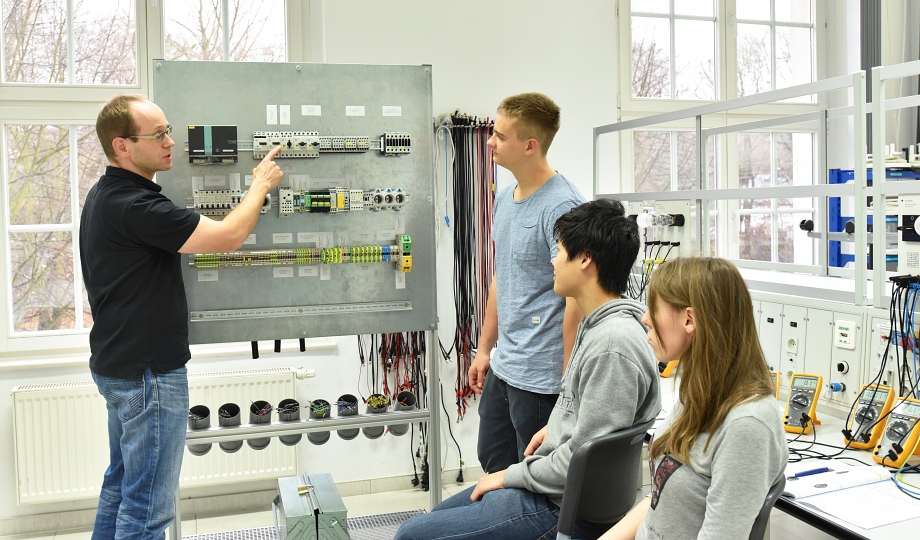
A trade school, also called a technical college or vocational school, focuses on career-specific training. Instead of a broad mix of general education courses, students spend most of their time learning the technical skills used in a specific field. That often means time in labs and shops working with the tools and equipment of the trade.
Trade and technical schools typically award certificates, diplomas, or career-focused associate degrees such as an Associate of Occupational Studies (AOS). Common fields include HVAC and refrigeration, electrical technology, instrumentation, automation, process technology, drafting, construction, and information technology.
What Is a Traditional 4-Year College?
 A 4-year college or university awards bachelor’s degrees. Students usually complete general education requirements in areas like English, math, science, history, and social sciences, along with courses in a chosen major. Many 4-year schools also offer graduate programs for students who want to continue to a master’s or doctoral degree.
A bachelor’s degree is required for many careers, including teaching, engineering, accounting, nursing at certain levels, and most professions that require graduate school.
Trade School Or 4-Year College: Side-By-Side Comparison
| Factor | Trade / Technical School | Traditional 4-Year College |
|---|---|---|
| Typical credential | Certificate, diploma, or career-focused associate degree | Bachelor’s degree |
| Typical length | Several months to about 2 years, depending on program | Designed for 4 years full time |
| Coursework | Concentrated on a specific trade or technical field | General education plus a major |
| Learning style | Heavy emphasis on hands-on lab and shop work | Mix of lectures, reading, research, and projects |
| Career direction | Focused on a specific occupation or industry | Broad range of fields, including those requiring graduate study |
Trade School Or 4-Year College: Time To Completion
Program length is one of the biggest differences. For HVAC, the Bureau of Labor Statistics notes that technicians typically need postsecondary instruction from technical and trade schools or community colleges, with programs generally lasting from 6 months to 2 years and leading to a certificate or an associate’s degree. Learn about other high-demand skilled trades you can train for in under 2 years.
Bachelor’s programs are designed to take four years, but many students take longer. According to the National Center for Education Statistics (NCES), by 2020, about 64 percent of first-time, full-time students who started a bachelor’s degree in fall 2014 had completed it at the same institution where they started. That doesn’t mean the path isn’t worthwhile. It means it’s smart to plan for the possibility that a degree could take more than four years.
Trade School Or 4-Year College: Cost And Value
Cost varies widely by school, so averages only tell part of the story. For example, NCES reports that in 2022–23, average tuition and fees at 4-year institutions were $9,800 at public institutions, $18,200 at private for-profit institutions, and $40,700 at private nonprofit institutions. At 2-year institutions, average tuition and fees were $4,000 at public institutions, $16,300 at private for-profit institutions, and $19,500 at private nonprofit institutions.
However, tuition is only one piece of what you pay. NCES notes that the total cost of attending includes tuition and required fees, books and supplies, and the average cost for room, board, and other expenses. The price on paper also doesn’t show what you get for it, or how likely you are to finish and start earning. When comparing schools, look at the full value, not just the sticker price.
Factors That Affect The Real Cost Of Your Education
- Finishing on time. Every extra term adds tuition, fees, and living costs, and delays when you start earning. Ask each school how long its students typically take to finish.
- Class scheduling. Some schools schedule your classes for you in a set sequence, so you aren’t competing for seats or waiting a term for a required course. Others leave scheduling up to you. A clear path can make it easier to finish on time.
- Tutoring and academic support. Ask whether tutoring is included at no extra cost and how easy it is to get help from instructors.
- Career services. Ask what help the school provides with resumes, interviews, and connecting with employers, both before and after graduation.
- Graduation rates. A program only pays off if you complete it. Each school’s graduation rate is available on College Navigator.
- Income after graduation. What graduates earn in the years after finishing matters as much as what the program costs.
You can check much of this yourself using free federal tools. The IPEDS College Navigator from NCES shows costs, financial aid, and graduation rates for individual schools. The U.S. Department of Education’s College Scorecard lets you compare the median earnings and median debt of a school’s graduates, based on their chosen field of study. In addition, colleges that accept federal financial aid must report data for the College Scorecard. Each school’s Net Price Calculator can also estimate your cost based on your own situation.
Trade School Or 4-Year College: Earnings And Career Outlook
Earnings depend heavily on the occupation, not just the type of school. The BLS publishes median earnings by level of education, but it notes that these education categories reflect only the highest level of educational attainment and do not take into account completion of training programs such as apprenticeships and other on-the-job training, which may also influence earnings and unemployment rates.
That’s why it helps to look at the specific career you want. For example, the BLS reports that the median annual wage for heating, air conditioning, and refrigeration mechanics and installers was $61,010 in May 2025, compared with $50,980 for all occupations. The BLS also projects that employment of HVAC mechanics and installers will grow 11 percent from 2025 to 2035, much faster than the average for all occupations, with about 40,600 openings projected each year, on average, over the decade. In a related field, electricians had a 2025 median pay of $63,190. For more on this career, read Launch Your Career As An HVAC Technician.
Wages vary by location, experience, and employer, and no school can guarantee employment or a specific salary. Finally, the BLS Occupational Outlook Handbook is a reliable place to research pay, education requirements, and job outlook for hundreds of careers.
Financial Aid
Financial aid isn’t limited to 4-year colleges. Accredited trade and technical schools that participate in federal student aid programs can offer grants and loans to eligible students. Depending on where you live, state programs and scholarships may also apply. Start with the FAFSA at StudentAid.gov, then talk to each school’s financial aid office about what you may qualify for.
Questions to Ask Yourself
- What career do you want? If your goal requires a bachelor’s or graduate degree, a 4-year college is the route. If it’s a skilled technical field, a trade program may be designed for it.
- How do you learn best? Some students thrive in lectures and research. Others learn best by working with their hands.
- How soon do you want to start working? Shorter programs can mean entering the workforce sooner. Longer programs offer more breadth.
- What will it really cost? Compare the total cost through completion, along with the support, graduation rates, and graduate earnings that come with it.
- Are you still exploring? If you aren’t sure what you want to do, a broader education can give you time to figure it out. If you already know, a focused program may make sense.
- What do the numbers say? Look up each school you’re considering on College Navigator and College Scorecard.
Sources
- National Center for Education Statistics, Fast Facts: Tuition Costs of Colleges and Universities
- National Center for Education Statistics, Fast Facts: Undergraduate Graduation Rates
- NCES IPEDS College Navigator
- U.S. Department of Education, College Scorecard
- U.S. Bureau of Labor Statistics, Occupational Outlook Handbook: Heating, Air Conditioning, and Refrigeration Mechanics and Installers
- U.S. Bureau of Labor Statistics, Career Outlook: Education Pays, 2025
- U.S. Bureau of Labor Statistics, Employment Projections: Unemployment Rates and Earnings by Educational Attainment
Program availability, length, and outcomes vary. ITI Technical College does not guarantee employment or salary. Financial aid is available for those who qualify.
Explore Your Options at ITI Technical College
If a hands-on technical career sounds like the right fit, ITI Technical College in Baton Rouge offers Associate of Occupational Studies degrees and certificate programs in fields including Air Conditioning, Refrigeration & Electrical Technology, Instrument & Control Systems Technology, Automation & Electronic Systems Technology, Process Technology, Information Technology, Construction Management, and Drafting & Design Technology.
At ITI, classes are scheduled for you, tutoring is available at no extra cost, and Career Services supports students and graduates. Schedule a campus tour, talk with an admissions advisor at (225) 752-4233, or explore our programs to learn more. Financial aid is available for those who qualify.
Disclosure:
For more information about graduation rates, the median debt of students who completed the program, and other important information, please visit our website: https://iticollege.edu/disclosures/