
New HVAC graduates must own a core set of reliable tools to begin their careers, focusing on electrical diagnostics, system evacuation, and hand tool essentials. Key items include an RMS multimeter, manifold gauges, vacuum pump, cordless drill/impact driver, specialized screwdrivers, snips, safety gear, and power tools. These tools ensure proficiency in troubleshooting, repair, installation, and maintenance of HVAC systems. Most graduates gain this knowledge during their associate degree training and in on-the-job orientation. Contact ITI Technical College today for more information.
Core HVAC Technician Tools
 HVAC graduates need core diagnostic, electrical, and hand tools to perform their services. They should purchase the best quality tools they can afford and upgrade as their income allows. These are the essentials that HVAC professionals recommend:
- True-RMS Multimeter: Crucial for measuring voltage, amperage, and capacitance. A clamp meter function is essential.
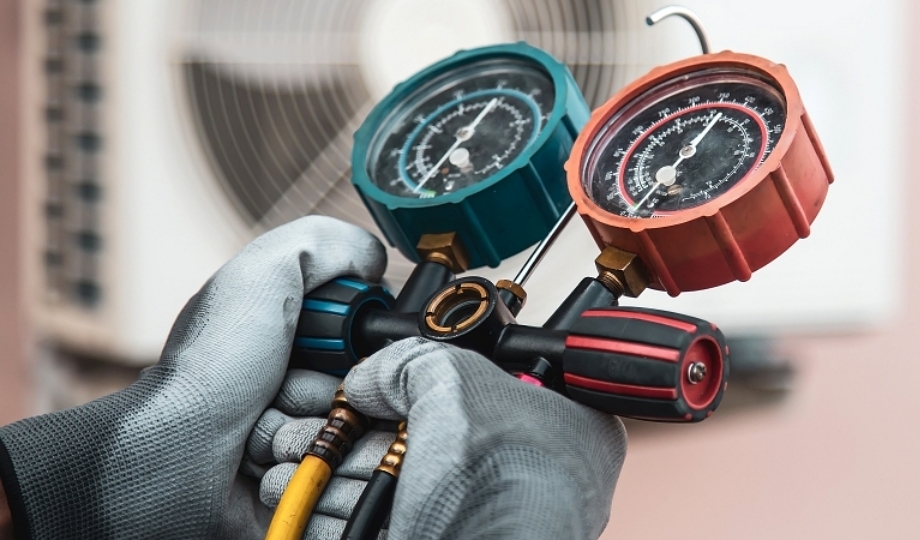
- Digital/Analog Manifold Gauges: Used for measuring system pressures.
- Micron Gauge/Vacuum Gauge: Essential for ensuring proper system evacuation; far more accurate than relying on a manifold gauge alone.
- Non-Contact Voltage Tester: For safely verifying power is off.
- Pipe Cleaners/Swaggers: Hydraulic swaging tools and fine set cleaners simplify tubing preparation.
- Refrigerant Leak Detector: Identifies leaks in coils or lines.
- Nitrogen Regulator: Controls pressure for testing lines.
- Headlamp/Flashlight: A hands-free headlamp is vital for dark crawlspaces or attics.
HVAC Technician Hand Tools
Every new technician graduate needs a basic set of hand tools to provide a variety of services for residential and commercial customers that include:
- Multi-Bit Screwdriver & Nut Drivers: Insulated 9-in-1 screwdrivers and magnetic nut drivers (3/8″ and 5/16″) are used daily.
- Wrenches: Adjustable wrenches ( 6″, 10″ 12″ ), crescent wrenches, and refrigeration wrenches for service valves.
- Pliers: Channel locks, needle-nose pliers, and lineman’s pliers.
- Sheet Metal Snips: Left, right, and straight cutting snips.
- Tubing Tools: Tube cutters and a swaging/flaring kit for copper pipe connections.
- Recovery Machine: Required for safely removing refrigerant.
- Digital Thermometers/Psychrometer: Measures temperature and humidity for airflow checks.
- Combustion Analyzer: Measures efficiency of furnaces.
- Thermal Imaging Cameras: Used to detect heat loss, motor issues, or blockage.
- Tape measure and level: Essential tools for accurate installation.
- Backpack: Everyone needs a durable backpack or service bags to organize and transport equipment and tools.
|
“New HVAC graduates must own a core set of reliable tools to begin their careers, focusing on electrical diagnostics, system evacuation, and hand tool essentials.” |
Power Tools And Jobsite Equipment
New HVAC technicians need the necessary power tools and jobsite equipment to handle their work. They should purchase as many power tools as they can afford and the balance as they gain experience. A cordless drill/impact driver is a reliable, versatile tool for drilling and fastening. A reciprocating saw (Sawzall) is critical for cutting pipe, metal, and ductwork. An Oscillating Multi-Tool is useful for precise cuts in tight spaces. An Angle Grinder is necessary for cutting or grinding heavy metal. A vacuum pump is used to remove moisture from refrigeration lines.
Technicians often rely on brands such as Milwaukee’s reciprocating saw, Dewalt, Fieldpiece, Testo, and Klein Tools. Specialized tools, such as the Top 10 Power Tools from Toolmart, ensure technicians are prepared for daily tasks.
Safety Gear For Protection

Safety is the Milwaukee priority for every HVAC technician on every job in residential or commercial assignments. Technicians should own and take the following safety gear with them to job sites:
- Safety Glasses & Gloves: To protect against flying debris and chemical burns.
- Hearing Protection: Use earplugs when noise is at a high level.
- Helmet: Needed for commercial and industrial jobs.
- Voltage Tester: For safe, live-circuit troubleshooting.
- First Aid Kit: Used for minor cuts, abrasions, or burns.
For an extensive guide on the essential tools for a new HVAC technician, you can refer to the detailed recommendations from the Southern Careers Institute.
HVAC Training At ITI Technical College
The objective of this program is to prepare graduates to work as entry-level service and maintenance technicians in the general field of Heating, Ventilation, Air Conditioning, and Refrigeration. Graduates will be prepared to work in the electrical field and will be able to install, repair, and maintain a wide variety of electrical equipment. Graduates must pass the EPA Section 608 test if employment in HVAC is the main objective for training.
The Air Conditioning, Refrigeration, & Electrical Technology Program teaches basic concepts, skills, and terminology for graduates to obtain entry-level jobs in this occupation. The HVAC program is accredited by three national organizations in the area of HVACR. This accelerated, hands-on training program is meaningful for students who want to earn an associate degree or improve their theory skills and knowledge in their current positions.
- Fundamentals of heat transfer, refrigerants, basic electricity and circuits, and regulations governing HVAC systems.
- Electrical safety, motor controls, basic and advanced programmable logic controllers (PLCs), and the National Electric Code (NEC).
- Safe work practices, environmental practices, and ethics practices.
- AC load calculations, applications, and troubleshooting of heating, air conditioning, and refrigeration systems, wiring methods, and lighting.
- Intro to Personal Computer office applications and computer networking, workplace communications, and one elective course related to each student’s interest.
Students learn to work with equipment and system components on field-grade equipment in classroom and laboratory activities. HVAC certification exams are given during the program to allow students to meet industry requirements in the area of HVAC/R. This accelerated, hands-on training program is meaningful for students who want to earn an associate degree or improve their theory skills and knowledge in their current positions.
Contact ITI Technical College today for more information about our Air Conditioning, Refrigeration, & Electrical Technology (AOS) Associate in Occupational Studies Degree.
Disclosure:
For more information about graduation rates, the median debt of students who completed the program, and other important information, please visit our website: https://iticollege.edu/disclosures/